
 By
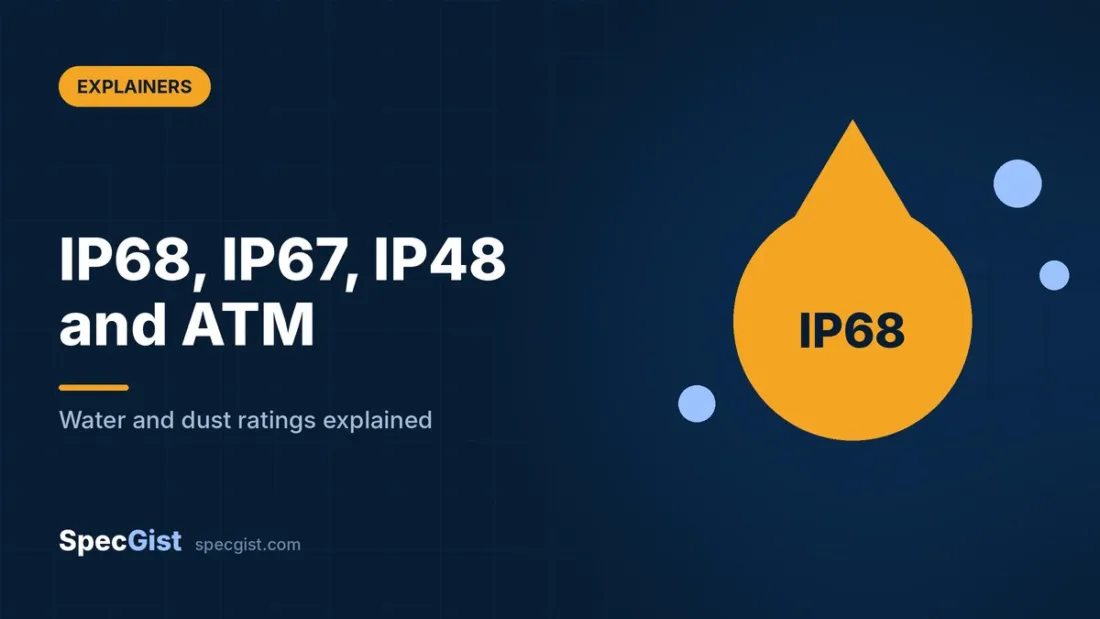
IP ratings tell you how well a phone or watch is protected against water and dust.
Water and dust ratings appear on almost every spec sheet, but the codes can be confusing. Here is how to read them.
How IP codes work
IP stands for “Ingress Protection”. The rating has two digits:
- First digit (0–6): solids and dust. 5 means dust-protected; 6 means dust-tight. 4 means protection against solid objects larger than 1 mm.
- Second digit (0–9): water. 4 means splashes, 5 means water jets, 7 means immersion up to 1 metre, 8 means immersion beyond 1 metre (the depth and time are set by the manufacturer), and 9 means protection against high-pressure, high-temperature water jets.
An “X” means that part was not tested. IPX8, for example, means water-resistant to immersion but with no dust rating.
Common ratings and examples
| Rating | Meaning | Example |
|---|---|---|
| IP68 | Dust-tight, immersion beyond 1 m | Galaxy S26 Ultra (1.5 m, 30 min), iPhone 17 (6 m, 30 min) |
| IP68/IP69 | Dust-tight, immersion and high-pressure jets | Tecno Spark Go 3 Pro |
| IP67 | Dust-tight, immersion up to 1 m | Galaxy A56 5G, iPhone SE (2022) |
| IP64 | Dust-tight, splashes | Tecno Spark Go 3 |
| IP48 | Objects over 1 mm, immersion | Galaxy Z Fold7, Galaxy Z Flip8 |
| IPX8 | Immersion, dust not rated | Pixel 9 Pro Fold |
Why foldables have lower ratings
A folding phone has a moving hinge with gaps that are hard to seal against fine dust and sand. That is why most foldables carry ratings like IP48 or IPX8: they can survive water, but dust and sand are their weak point. Apple’s iPhone Duo is an exception, rated IP68.
ATM ratings on watches
Smartwatches often use ATM (atmospheres) instead of, or as well as, IP ratings. 5ATM means the watch can handle pressure equal to a 50-metre depth in a static test, which in practice means it is suitable for swimming in a pool or the sea, but not for diving or high-speed water sports. The Pixel Watch and Pixel Watch 5 are rated 5ATM, and the Galaxy Watch3 is rated IP68 and 5ATM.
Important limits
- Ratings are tested in fresh water in a lab. Salt water, chlorine, soap and hot water can damage seals.
- Seals wear out over time and can be damaged by drops or repairs.
- Most manufacturers do not cover water damage under warranty, even on rated phones.
- Don’t charge a phone while its port is wet.
A rating is best thought of as protection against accidents, not permission to take your phone swimming.
The IP code is defined by the IEC. You can read their own explanation on the IEC IP ratings page.
IP ratings: frequently asked questions
Is IP68 waterproof?
Not fully. IP68 means dust-tight and protected against immersion beyond 1 metre in fresh water, for a depth and time set by the manufacturer. It is water-resistant, not waterproof.
What is the difference between IP67 and IP68?
Both are dust-tight. IP67 covers immersion up to 1 metre, while IP68 covers immersion beyond 1 metre, for example 1.5 m or 6 m for 30 minutes depending on the phone.
What does IP69 mean?
IP69 adds protection against high-pressure, high-temperature water jets. It is rare on phones; the Tecno Spark Go 3 Pro is one example on our site.
Can I swim with an IP68 phone?
It is not recommended. Pool chlorine, salt water and moving water can get past the seals, and most manufacturers don’t cover water damage under warranty.
Does water resistance last forever?
No. Seals wear with age, drops and repairs, so an older phone may be less protected than its rating suggests.
What does 5ATM mean on a watch?
5ATM means a watch can handle pressure equal to a 50-metre depth in a static test. It is suitable for swimming in a pool or the sea, but not for diving.

Leave a comment