
 By
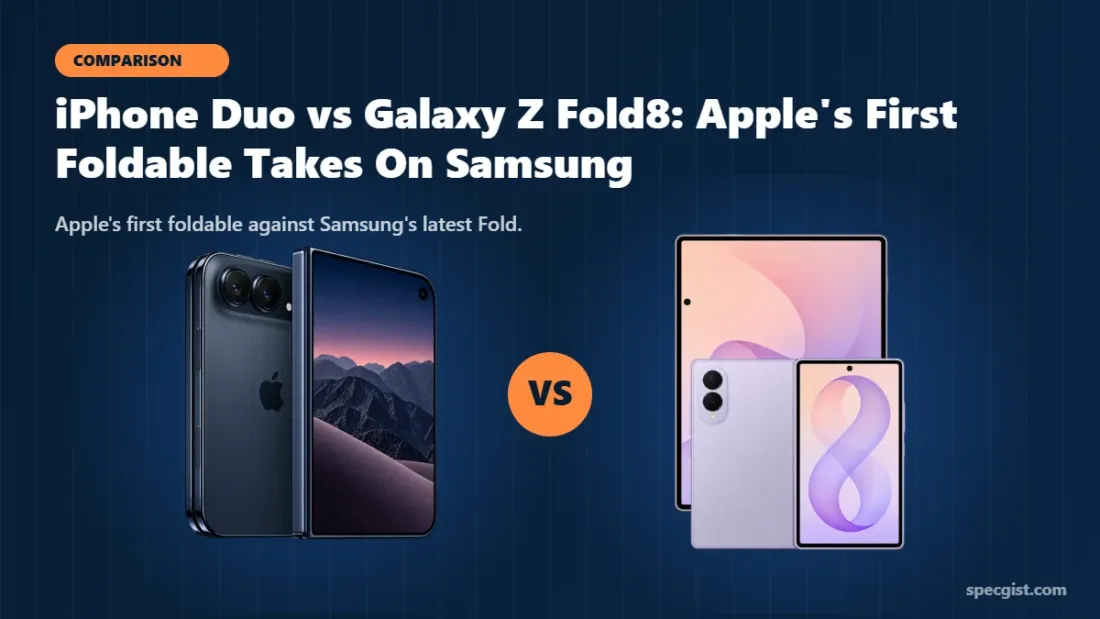
iPhone Duo vs Galaxy Z Fold8 has been a hot topic for weeks. For years, Samsung had the book-style foldable market almost to itself. That changed in October 2026 when Apple released the iPhone Duo, its first foldable iPhone. Its most direct rival is the Galaxy Z Fold8, Samsung’s eighth-generation Fold, released in August 2026.
Both open into a 7.6-inch tablet-sized screen, both use the fastest chips of 2026, and both cost far more than a normal flagship. Here is how they compare, using the full specifications on SpecGist.
Quick verdict
Here is the short answer to iPhone Duo vs Galaxy Z Fold8, before the details.
- Choose the iPhone Duo if you already use Apple devices, or want stronger water resistance (IP68), a titanium frame and hinge, Apple Pencil support and Apple’s video tools.
- Choose the Galaxy Z Fold8 if you want a thinner and much lighter foldable, a physical SIM slot, 8K video, longer guaranteed updates and a price about $500 lower.
Want every spec side by side? Open the full iPhone Duo vs Galaxy Z Fold8 comparison, with every spec section, the size drawing and the network checker.
iPhone Duo vs Galaxy Z Fold8: key specs at a glance
Overview6
| Spec | Apple iPhone Duo | Samsung Galaxy Z Fold8 |
|---|---|---|
| SpecGist Score | 7.9 / 10 · Very good | 8.4 / 10 · Very good Best |
| Brand | Apple | Samsung |
| Versions | A3720 (International); A3447 (USA); A3719 (Middle East, Canada, Mexico); A3721 (China) | — |
| Announced | 2026, September 09 | 2026, July 22 |
| Released | 2026, October 23 | 2026, August 07 |
| Availability | Available | Available |
Price
On price, iPhone Duo vs Galaxy Z Fold8 is not a close contest. The iPhone Duo starts at $1,999 with 256GB of storage and goes up to 2TB. The Galaxy Z Fold8 lists at $1,499 for 256GB and goes up to 1TB, where it also gets 16GB of RAM. That $500 gap is the single biggest difference between them, and Samsung foldables usually get discounts within a few months of launch.
Design and durability
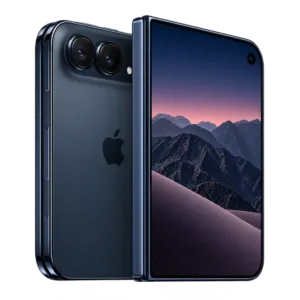
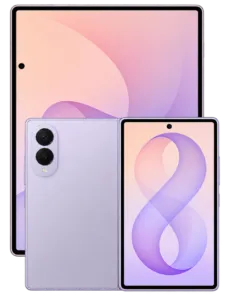
In the hand, the biggest iPhone Duo vs Galaxy Z Fold8 difference is weight. The Fold8 is the slimmer and lighter phone: 4.5 mm thin when open, 9.7 mm when closed, and 201 g. The iPhone Duo is 5.2 mm open, 11.3 mm closed and 254 g, which is heavier than an iPhone 18 Pro Max. If you carry your phone in a pocket all day, the Samsung is noticeably easier to live with.
Apple answers with materials and protection. The Duo has a grade 5 titanium frame and hinge, Ceramic Shield glass and an IP68 rating, so it is dust tight and rated for 6 metres of water for 30 minutes. The Fold8 uses an aluminium frame and is rated IP48: good against water, but only protected against dust particles larger than 1 mm. Fine sand at the beach is still a risk for the Samsung’s hinge.
Both are wide when folded: the iPhone Duo measures 117.8 x 84.1 mm closed, and the Fold8 123.9 x 81.9 mm. That shape makes typing on the outer screen feel more natural than on older, narrow Folds.
Body6
| Spec | Apple iPhone Duo | Samsung Galaxy Z Fold8 |
|---|---|---|
| Dimensions | Unfolded: 117.8 x 164.6 x 5.2 mm Folded: 117.8 x 84.1 x 11.3 mm | Unfolded: 161.4 x 123.9 x 4.5 mm Folded: 81.9 x 123.9 x 9.7 mm |
| Weight | 254 g (8.96 oz) | 201 g (7.09 oz) Best |
| Build | Glass front (Ceramic Shield 2) (folded) Titanium frame & hindge (grade 5) Glass back (Ceramic Shield) | Glass front (Gorilla Glass Ceramic 3) (folded), plastic front (unfolded), glass back (Gorilla Glass Victus 2), aluminum frame (Armor Aluminum) |
| Stylus | Yes, support Apple Pencil (USB-C) model | — |
| SIM | · eSIM + eSIM (8 or more, max 2 at a time) - Global · eSIM + eSIM (China) | Nano-SIM + eSIM + eSIM (max 2 at a time) |
| Protection / IP Rating | IP68 dust tight and water resistant (immersible up to 6m for 30 min) | IP48 dust and water resistant (dust > 1mm; immersible up to 1.5m for 30 min) |
Displays
Both inner screens are 7.6 inches with 120Hz refresh rates and 3,000 nits peak brightness. The Duo’s panel is slightly sharper, at about 430 ppi (1878 x 2670) against about 404 ppi (2448 x 1848) on the Fold8, though the difference is hard to see at normal distance. Apple’s screen has a matte, nano-texture finish with an anti-reflective coating, which cuts glare in bright light. The Fold8 also has an anti-reflective coating.
The iPhone Duo supports the Apple Pencil (USB-C), which makes the big screen useful for notes and sketches. The Fold8 has no stylus support listed.
Display8
| Spec | Apple iPhone Duo | Samsung Galaxy Z Fold8 |
|---|---|---|
| Display Type | LTPO Super Retina XDR OLED | Foldable Dynamic LTPO AMOLED 2X |
| Display Size | 7.6 inches, 175.4 cm2 (~90.4% screen-to-body ratio) | 7.6 inches, 179.2 cm2 (~89.6% screen-to-body ratio) |
| Resolution | 1878 x 2670 pixels | 2448 x 1848 pixels, 4:3 ratio |
| Pixel Density | ~430 ppi Best | ~404 ppi |
| Refresh Rate | 120Hz | 120Hz |
| Peak Brightness | 1000 nits (typ), 1600 nits (HBM), 3000 nits (peak) | 3000 nits Best |
| Protection | Nano Texture finish Anti‑reflective coating | — |
| Display Features | HDR10, Dolby Vision, Wide-angle OLED matte display | Anti-reflective coating Flex Titanium technology |
Cover Display8
| Spec | Apple iPhone Duo | Samsung Galaxy Z Fold8 |
|---|---|---|
| Display Type | LTPO Super Retina XDR OLED | Dynamic LTPO AMOLED 2X |
| Display Size | 5.4 inches | 5.5 inches Best |
| Resolution | 1398 x 2034 pixels | 1248 x 1972 pixels |
| Pixel Density | 460 ppi Best | ~428 ppi |
| Refresh Rate | 120Hz | 120Hz |
| Peak Brightness | 1000 nits (typ), 1600 nits (HBM), 3000 nits (peak) | 3000 nits Best |
| Protection | Ceramic Shield 2, Anti‑reflective coating | Corning Gorilla Glass Ceramic 3 |
| Display Features | HDR10, Dolby Vision | — |
Performance and software
The iPhone Duo uses the A20 Pro with 12GB of RAM, the same chip as the iPhone 18 Pro models. The Fold8 uses the Snapdragon 8 Elite Gen 5 with 12GB or 16GB of RAM. Both are top-tier chips and handle split-screen apps, games and video editing easily.
Software may decide it for you. The Duo runs iOS 27 and works seamlessly with Macs, AirPods and Apple Watch. The Fold8 runs Android 17 with Samsung’s One UI, which has years of foldable refinement in multi-window and taskbar features, and Samsung promises up to seven major Android updates.
Platform8
| Spec | Apple iPhone Duo | Samsung Galaxy Z Fold8 |
|---|---|---|
| Operating System | iOS | Android |
| OS Version | 27 | 17 |
| Update Support | — | Upgradeable to up to 7 major OS updates |
| Updates until | — | 2033 (Aug) · 6 years 8 months left |
| User Interface | — | One UI 9 |
| Chipset | Apple A20 Pro (2 nm) | Qualcomm SM8850-1-AD Snapdragon 8 Elite Gen 5 (3 nm) |
| CPU | Hexa-core (2x GHz high performance + 4x GHz) | Octa-core (2x4.74 GHz Oryon V3 Phoenix L + 6x3.62 GHz Oryon V3 Phoenix M) |
| GPU | Apple GPU (7-core graphics) | Adreno 840 (1.3GHz) |
Memory4
| Spec | Apple iPhone Duo | Samsung Galaxy Z Fold8 |
|---|---|---|
| RAM Options | 12GB | 12GB, 16GB |
| Storage Options | 256GB / 12GB RAM 512GB / 12GB RAM 1TB / 12GB RAM 2TB / 12GB RAM | 256GB / 12GB RAM 512GB / 12GB RAM 1TB / 12GB RAM 1TB / 16GB RAM |
| Storage Type | NVMe | UFS 4.x |
| Card Slot | No | No |
Cameras
Cameras are the closest part of the iPhone Duo vs Galaxy Z Fold8 match-up. Neither phone has a telephoto lens, which is the main compromise of both. The iPhone Duo has a 48 MP main camera with sensor-shift OIS and a 48 MP ultrawide. The Fold8 has a 50 MP main camera with OIS and a 50 MP ultrawide. Expect very similar results in good light.
For video, the iPhone records 4K at up to 120fps with Dolby Vision HDR, while the Fold8 adds 8K at 30fps and 4K at 120fps. For selfies, the iPhone has a 12 MP cover camera and a 4 MP under-display camera on the inner screen; the Fold8 has two 10 MP selfie cameras.
Main Camera4
| Spec | Apple iPhone Duo | Samsung Galaxy Z Fold8 |
|---|---|---|
| Cameras | Dual camera | Dual camera |
| Modules | 48 MP, f/1.6, 26mm (wide), PDAF, sensor-shift OIS 48 MP, f/2.2, 13mm, 120˚ (ultrawide), 1/2.55", 0.7µm, PDAF | 50 MP, f/1.8, 23mm (wide), 1/1.56", 1.0µm, dual pixel PDAF, OIS 50 MP, f/1.9, 13mm, 120˚ (ultrawide), 1/2.51", 0.7µm, multi-directional PDAF Best |
| Features | Dual-LED dual-tone flash, HDR (photo/panorama) | LED flash, HDR, panorama |
| Video | 4K@24/25/30/60/100/120fps, 1080p@25/30/60/120/240fps, 10-bit HDR, Dolby Vision HDR (up to 120fps), ProRes, 3D (spatial) video/audio, stereo sound rec. | 8K@30fps, 4K@30/60/120fps, 1080p@30/60/120/240fps, gyro-EIS, OIS |
Selfie Camera4
| Spec | Apple iPhone Duo | Samsung Galaxy Z Fold8 |
|---|---|---|
| Cameras | Dual camera | Dual camera |
| Modules | 4 MP, f/1.8, 22mm (wide), under display camera (1080p@30/60fps) Cover camera: 12 MP multi-aspect, f/2.2, (wide), AF Best | 10 MP, f/2.2, 18mm (ultrawide), 1/3.52", 1.12µm Cover camera: 10 MP, f/2.2, 24mm (wide), 1/3.52", 1.12µm |
| Features | HDR, Dolby Vision HDR, spatial audio, stereo sound rec. | HDR |
| Video | 4K@24/25/30/60fps, 1080p@25/30/60/120fps, gyro-EIS | 4K@30/60fps, 1080p@30/60fps, gyro-EIS |
Battery and charging
Battery sizes are nearly the same: 4,883 mAh in the iPhone Duo and 4,800 mAh in the Fold8, which uses a newer silicon-carbon battery. The iPhone reaches 50% in about 20 minutes with a compatible charger and supports 25W MagSafe and Qi2 wireless charging. The Fold8 supports 45W wired charging (about 63% in 30 minutes), 20W wireless and 4.5W reverse wireless charging for earbuds.
Battery5
| Spec | Apple iPhone Duo | Samsung Galaxy Z Fold8 |
|---|---|---|
| Battery Type | Li-Ion | Si/C Li-Ion |
| Battery Capacity | 4883 mAh Best | 4800 mAh |
| Wired Charging | PD3.2, AVS, 50% in 20 min | 45W wired, QC2.0, 63% in 30 min Best |
| Wireless Charging | 25W wireless MagSafe/Qi2, 50% in 30 min Best | 20W wireless |
| Reverse Charging | — | 4.5W reverse wireless |
Security and SIM
The iPhone Duo has no Face ID; it uses a fingerprint reader in the side button instead. The Fold8 has a side fingerprint reader and 2D face unlock. The Duo is eSIM-only worldwide, while the Fold8 keeps a physical Nano-SIM slot plus eSIM. If you swap SIM cards often when travelling, that matters. Check the “Will it work in my country?” tool on each phone’s page before buying abroad.
Features & Security4
| Spec | Apple iPhone Duo | Samsung Galaxy Z Fold8 |
|---|---|---|
| Fingerprint | Yes (side-mounted) | Yes, (side-mounted) |
| Face Unlock | No Face ID | Yes, (2D face recognition) |
| Sensors | Accelerometer, gyro, proximity, compass, barometer | Accelerometer, gyro, proximity, compass, barometer |
| Other Features | Ultra Wideband (UWB) support (gen2 chip) Emergency SOS, Messages and Find My via satellite | Samsung DeX (desktop experience support) Ultra Wideband (UWB) support |
iPhone Duo vs Galaxy Z Fold8: which should you buy?
- iPhone Duo: best for Apple users who want a foldable that feels premium and tough, with IP68, titanium and Pencil support, and do not mind the weight or the price.
- Galaxy Z Fold8: best for most people who want a foldable: lighter, thinner, physical SIM, seven years of updates and $500 cheaper.
FAQ
iPhone Duo vs Galaxy Z Fold8: which is better?
It is tougher, with IP68 and a titanium frame, and better for Apple users. The Fold8 is lighter, thinner and cheaper, with longer promised updates.
Does the iPhone Duo have Face ID?
No. It uses a fingerprint reader built into the side button.
Which foldable is more water resistant?
The iPhone Duo, rated IP68. The Galaxy Z Fold8 is rated IP48, which means weaker protection against dust and sand.
How much does the iPhone Duo cost?
It starts at $1,999 in the US, about $500 more than the Galaxy Z Fold8.
See the full iPhone Duo specifications, the Galaxy Z Fold8 specifications, or compare any two phones with the SpecGist compare tool. For official details, see Apple’s iPhone page and Samsung’s Galaxy page.


Leave a comment